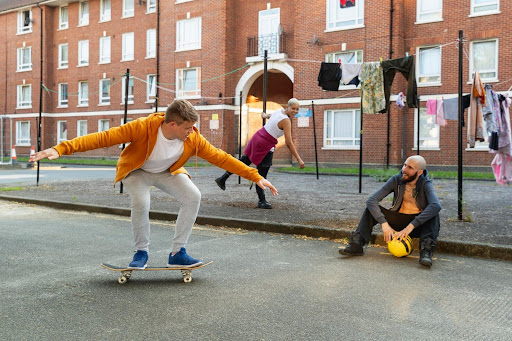
Even before the world shut down, street sports were in a peculiar limbo — alive but battling gyms, video gaming, and ever-more regulated public space. Then COVID struck. As city life ground to a halt and citizens remained indoors, deserted streets and shut courts transformed basketball hoops and skate parks into ghost towns.
But now, in a world gradually emerging from the pandemic’s dark shadow, street sports aren’t merely back — they’re growing indispensable again. There’s something about competing in the fresh air, face to face, unmediated by screens or apps, that seems more vital than ever. It’s not merely a sport. It’s about reclaiming public space, reconstituting community, and recalling what freedom tastes like when it’s seasoned with sweat and grazed knees.
A Changed Landscape and a New Urgency
The lockdowns made citizens rethink their physical spaces. While gyms closed and team sports were suspended, people set about making do — driveways as courts, rooftops as training grounds, and empty streets as running routes. The interventions reduced sport to its very essentials: space, movement, and human contact.
And now that officially built facilities are once more accessible, most individuals are holding on to the simplicity and informality of street play. Parks are more crowded. Pickup games are louder. The city is, literally, alive again.
Confronted with such resurgence, the online portals have taken stock. In an interesting twist, cross-fertilization between online entertainment and outdoor sports has given rise to new hybrid interests. Take, for example, the South Asian markets where demand for live casino Bangladesh sites remains on the rise, not merely among indoor enthusiasts. Mid-paragraph, this is part of an emerging trend in which sporting events betting and casino game sites also branch out into outdoor sports coverage, reaching a broader swath of consumers who are bridging physical action and digital thrills.
This blending of experience is an echo of the way in which people are consuming sport nowadays — half live, half streamed, half played, half watched. And the street sports offer the most raw, unedited version of that combination.
What’s New Since the Pandemic?
Though the rules of the game have not altered, drives and context certainly have. There’s a different vibe now — less about doing, more about connecting, more about being out here, together, alive.
Here’s how street sports have evolved in the post-COVID world:
| Change in Street Sports | Description | Why It Matters |
| Rise in Participation | People of all ages now engage more often in street sports | Signals a renewed desire for real-world activity and social play |
| Accessibility Over Prestige | The focus has shifted from competition to inclusion | Encourages broader participation and reduces pressure |
| DIY and Community Culture | Local tournaments, pickup games, and casual meetups have multiplied | Builds stronger neighborhood identity and encourages local talent |
| Digital Crossover | More content from street sports makes its way to social media platforms | Raises visibility and connects local games with global audiences |
This shift isn’t nostalgia; it’s pragmatism. Parents want their children off screens. Young adults want life-scale versions of socializing that aren’t too costly or too staged. And city planners are hearing them out — expanding skate park space, repainting court lines, and even shutting down city streets on weekends to accommodate play.
Community First, Algorithms Later
Walking through a city park today is different from walking through a city park five years ago. More carefree play. Less uniforms. More diversity of players, and of style. Organized leagues have their place, but expanding exponentially now is free-form, open play — the kind where rules are bent, teams get shuffled, and the only scoreboard is laughter and trash talk.

This grassroots is bleeding into online storytelling. Creators now videotape and disseminate street football games, basketball trick shots, and street-dance challenges from erstwhile untapped areas for mainstream sports media. In fact, some are being discovered by brands that otherwise would not be credited for outdoor play.
Take Melbet, for instance. Established specifically for online casino and betting operations, Melbet has shifted to expand its publicity agenda to a wider discussion of sporting culture. Halfway through the sentence, this illustrates the manner in which websites are becoming increasingly reliant on the unmediated, spontaneous passion of street sports in an effort to appeal to new consumers.
This kind of attention does not water down street sport — it turns it up. It allows kids with a phone and a killin’ crossover to compete for cyber stardom. And it tells cities that spending money on hoops, ramps, and open play areas isn’t retro — it’s intelligent.
Why Street Sports Are More Relevant Than Ever
Street sports are not just an exercise. They are about occupying space, being yourself, and being resilient. Post-COVID, a lot of people are still struggling with loneliness, mental illness, and screen burnout. Playing outside is probably the easiest way to disrupt that loop.
That is what street sports offer today:
- Mental Relief: Years of uncertainty, tension, and video time, interrupted by a walk outside and free movement, is strong medicine.
- Free and Inclusive: Anyone with a ball, some sneakers, or a board can participate. No membership cost, no equipment charges, and no strict format.
- Skill Meets Creativity: Free of rules or formats to adhere to, street sports foster experimentation, improvisation, and individual expression.
- Healthier Social Bonds: A five-minute game or an entire afternoon spent playing, shared body movement fosters trust, cooperation, and joy.
All of these advantages make street sports not only enjoyable but essential. In the increasingly engineered world built to keep us sitting and scrolling, they provide an off-ramp — a pathway back to touch, sweat, and spontaneity.
And they’re catching on. From Manila to Lagos, Rio to Dhaka, young people are claiming streets as their stadium. City energy is being channeled into movement, rhythm, and play. Even as technology keeps mapping out the future, the siren of the open court, the squeak of sneakers on the pavement, and the beat of a game emerged from nothing but presence — that’s one thing no algorithm can replicate.
Not a Comeback, It’s a Movement
Street sports are not merely coping in a post-COVID era — they’re thriving. Recast, recalibrated, and revered in the new environments, they’ve recaptured their turf not only on asphalt and concrete but also in cultural discourse.
What began as a necessity during a lockdown has turned into a movement. And if the rhythm of that bounce, that pass, that slam, keeps echoing through our neighborhoods — we’re all better for it.